2 Transmons with resonator, Capacitance and qubit parameters computation
[1]:
%load_ext autoreload
%autoreload 2
%matplotlib inline
import os
os.environ["KMP_DUPLICATE_LIB_OK"]="TRUE"
os.environ["PMIX_MCA_gds"]="hash"
os.environ['OMPI_MCA_btl'] = 'tcp,self'
os.environ['OMPI_MCA_rmaps_base_oversubscribe'] = '1'

# Import useful packages
from qiskit_metal import designs, draw
from qiskit_metal import MetalGUI, Dict, open_docs
from SQDMetal.Utilities.QUtilities import QUtilities
import matplotlib.pyplot as plt
from SQDMetal.Comps.Qubits import TransmonTaperedInsets
from SQDMetal.Comps.Test_capacitor import Smooth_CapacitorProngPin, Smooth_Capacitor_Semicircle
from SQDMetal.Comps.Resonators import ResonatorMeanderPinPin
from SQDMetal.Utilities.QubitDesigner import ResonatorHalfWave
from qiskit_metal.analyses import cpw_calculations
from SQDMetal.Utilities.Materials import Material
from SQDMetal.Utilities.CpwParams import CpwParams

### Qubit, resonator frequencies
qubit_freq = [4.5*1e9, 4.5*1e9]
res_freq_GHZ = qubit_freq[1] + 2.3 *1e9
Design
[2]:
## Resonator design parameters
resonator = ResonatorHalfWave(res_freq_GHZ)

m = Material("siliconcryo")

# CPW parameters
cpw_width = 10e-6
cpw = CpwParams(m.permittivity, 500e-6)
cpw_gap = cpw.get_gap_from_width(cpw_width)

l_fullwave, _, _ = cpw_calculations.guided_wavelength(
                freq=resonator.f0,
                line_width=cpw_width,
                line_gap=cpw_gap,
                substrate_thickness=cpw.dielectric_thickness,
                film_thickness=200e-9,
            )
l_halfwave = l_fullwave / 2

print(f"Resonator length (f = {res_freq_GHZ} GHz): {l_halfwave *1e3:.2f} mm")
Resonator length (f = 6800000000.0 GHz): 8.96 mm
[ ]:
%matplotlib inline

# Set up chip design as planar
design = designs.DesignPlanar({}, overwrite_enabled=True)

# Set up chip dimensions
design.chips.main.size.size_x = '5.0mm'
design.chips.main.size.size_y = '2.0mm'
design.chips.main.size.size_z = '-280um'
design.chips.main.size.center_x = '0.0mm'
design.chips.main.size.center_y = '0mm'

# Resonator and feedline gap width (W) and center conductor width (S)
design.variables['cpw_width'] = '10 um' #S
design.variables['cpw_gap'] = '6 um' #W

#gui = MetalGUI(design)


########################################

TransmonTaperedInsets(design, 'Qubit1', options = Dict(pos_x = '-1.25mm', pos_y = '0.0mm', orientation = '0',
                                                       pocket_lower_tighten = '0.0um',pocket_height = '420um',chrgln_pin_x_offset="0um", chrgln_pin_y_offset="-10um"))


TransmonTaperedInsets(design, 'Qubit2', options = Dict(pos_x = '1.65mm', pos_y = '0.0mm', orientation = '0',
                                                       pocket_lower_tighten = '0.0um',pocket_height = '420um', chrgln_pin_x_offset="0um", chrgln_pin_y_offset="-10um"))


Smooth_Capacitor_Semicircle(design, 'Capacitor1',options=Dict(pin_inputs=Dict(start_pin=Dict(component=f'Qubit1',pin='top_right_pin')), orientation=180,
                                                              rect_width = '160um',rect_length = '80um', semi_radius = '60um',
                                                              fillet_radius = '5um',fillet_resolution = 20))

Smooth_Capacitor_Semicircle(design, 'Capacitor2',options=Dict(pin_inputs=Dict(start_pin=Dict(component=f'Qubit2',pin='top_left_pin')), orientation=0,
                                                              rect_width = '160um',rect_length = '80um', semi_radius = '60um',
                                                              fillet_radius = '5um',fillet_resolution = 20))

ResonatorMeanderPinPin(design, 'Resonator1', options = Dict(pin_inputs=Dict(start_pin=Dict(component='Capacitor1', pin='a'),
                                                            end_pin=Dict(component='Capacitor2', pin='a')),
                                            total_length = f"{l_halfwave*1e3}mm", start_left = False,
                                            trace_width = design.variables['cpw_width'], gap_width = design.variables['cpw_gap']))


#######################################

# Create GUI
#gui.rebuild()
design.rebuild()
[4]:
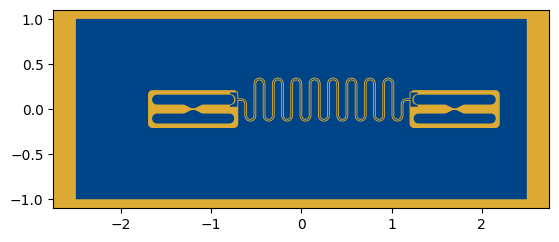
QUtilities.plot_all_components(design)
plt.show()
Capacitance Simulation
[5]:
from SQDMetal.PALACE.Capacitance_Simulation import PALACE_Capacitance_Simulation
import contextlib
import sys
from io import StringIO

#Eigenmode Simulation Options
user_defined_options = {
                "mesh_refinement": 0,                             #refines mesh in PALACE - essetially divides every mesh element in half
                "dielectric_material": "silicon",                  #choose dielectric material - 'silicon' or 'sapphire'
                "solver_order": 2,                                 #increasing solver order increases accuracy of simulation, but significantly increases sim time
                "solns_to_save": 3,                                #number of solutions to save for E-field visualization - ordered by the entries in the computed capacitance matrix
                "solver_tol": 1.0e-8,                              #error residual tolerance for iterative solver
                "solver_maxits": 200,                              #number of solver iterations
                "fillet_resolution":16,                            #number of vertices per quarter turn on a filleted path
                "palace_dir":"~/repo/spack/opt/spack/linux-skylake/palace-0.15.0-p26f6lzvfjt4qemxgkdpjhhyogo7axk4/bin/palace",#"PATH/TO/PALACE/BINARY",
                "num_cpus": 16,                                  #number of threads to use in PALACE simulation
                #e.g.: "palace_dir":"/home/prasanna/spack/opt/spack/linux-ubuntu24.04-zen2/gcc-13.2.0/palace-0.12.0-q65qvkwsa5zglixv3rmm424wqsu3mcpv/bin/palace"
                }

#Create the Palace capacitance simulation
cap_sim = PALACE_Capacitance_Simulation(name = '2_transmons_wRes_comp',                                      #name of simulation
                                        metal_design = design,                                      #feed in qiskit metal design
                                        sim_parent_directory = "",                                  #choose directory where mesh file, config file and HPC batch file will be saved
                                        mode = 'simPC',                                             #choose simulation mode 'HPC' or 'simPC'
                                        meshing = 'GMSH',                                           #choose meshing 'GMSH' or 'COMSOL'
                                        user_options = user_defined_options,                        #provide options chosen above
                                        create_files = True)                                        #create mesh, config and HPC batch files

#Add metallic elements from layer 1 in design file
cap_sim.add_metallic(1)

#Add ground plane to simulations
cap_sim.add_ground_plane()

#Fine mesh the transmon cross qubit region
cap_sim.fine_mesh_components(['Qubit1', 'Qubit2'], min_size=12e-6, max_size=100e-6, taper_dist_min=10e-6, metals_only=False)

#Fine mesh resonator, launch pads and transmission line
cap_sim.fine_mesh_components(['Resonator1','Capacitor1','Capacitor2'], min_size=12e-6, max_size=120e-6, taper_dist_min=10e-6)

#This will prepare the mesh file and the config file
cap_sim.prepare_simulation()

capMat = cap_sim.run()
Error   : Gmsh has not been initialized
Error   : Gmsh has not been initialized
>> /usr/bin/mpirun -n 16 /home/leont/repo/spack/opt/spack/linux-skylake/palace-0.15.0-p26f6lzvfjt4qemxgkdpjhhyogo7axk4/bin/palace-x86_64.bin 2_transmons_wRes_comp.json

_____________     _______
_____   __   \____ __   /____ ____________
____   /_/  /  __ ` /  /  __ ` /  ___/  _ \
___   _____/  /_/  /  /  /_/  /  /__/  ___/
  /__/     \___,__/__/\___,__/\_____\_____/


--> Warning!
Output folder is not empty; program will overwrite content! (outputFiles)
Git changeset ID: b676277
Running with 16 MPI processes
Device configuration: cpu
Memory configuration: host-std
libCEED backend: /cpu/self/xsmm/blocked

Added 1128 boundary elements for material interfaces to the mesh
Finished partitioning mesh into 16 subdomains

Characteristic length and time scales:
 Lc = 6.000e-03 m, tc = 2.001e-02 ns

Mesh curvature order: 1
Mesh bounding box:
 (Xmin, Ymin, Zmin) = (-3.000e-03, -1.200e-03, -2.800e-04) m
 (Xmax, Ymax, Zmax) = (+3.000e-03, +1.200e-03, +2.800e-04) m

Parallel Mesh Stats:

                minimum     average     maximum       total
 vertices          2240        2650        2939       42414
 edges            16179       17320       18508      277120
 faces            28065       29055       30271      464891
 elements         14061       14386       14702      230184
 neighbors            3           5           9

            minimum     maximum
 h      0.000296999   0.0313019
 kappa      1.02042     92.4409

Configuring Dirichlet BC at attributes:
 10-15, 1-6

Assembling system matrices, number of global unknowns:
 H1 (p = 2): 319534, ND (p = 2): 1484022, RT (p = 2): 2085225
 Operator assembly level: Partial
 Mesh geometries:
  Tetrahedron: P = 20, Q = 11 (quadrature order = 4)

Assembling multigrid hierarchy:
 Level 0 (p = 1): 42414 unknowns
 Level 1 (p = 2): 319534 unknowns

Computing electrostatic fields for 6 terminal boundaries

It 1/6: Index = 1 (elapsed time = 1.66e-07 s)

  Residual norms for PCG solve
  0 KSP residual norm ||r||_B = 2.448392e+01
  1 KSP residual norm ||r||_B = 2.121257e+00
  2 KSP residual norm ||r||_B = 2.539193e-01
  3 KSP residual norm ||r||_B = 4.098513e-02
  4 KSP residual norm ||r||_B = 8.845225e-03
  5 KSP residual norm ||r||_B = 2.156941e-03
  6 KSP residual norm ||r||_B = 5.551920e-04
  7 KSP residual norm ||r||_B = 1.567196e-04
  8 KSP residual norm ||r||_B = 3.739797e-05
  9 KSP residual norm ||r||_B = 8.646898e-06
 10 KSP residual norm ||r||_B = 2.243936e-06
 11 KSP residual norm ||r||_B = 5.988850e-07
PCG solver converged in 11 iterations (avg. reduction factor: 1.697e-01)
 Sol. ||V|| = 3.122235e+02 (||RHS|| = 1.780161e+02)
 Field energy E = 1.035e-09 J

 Wrote fields to disk (Paraview) for source 1
 Updating solution error estimates

It 2/6: Index = 2 (elapsed time = 6.59e+00 s)

  Residual norms for PCG solve
  0 KSP residual norm ||r||_B = 5.905616e+00
  1 KSP residual norm ||r||_B = 7.014801e-01
  2 KSP residual norm ||r||_B = 1.434889e-01
  3 KSP residual norm ||r||_B = 3.431404e-02
  4 KSP residual norm ||r||_B = 8.626627e-03
  5 KSP residual norm ||r||_B = 2.194025e-03
  6 KSP residual norm ||r||_B = 5.414656e-04
  7 KSP residual norm ||r||_B = 1.075673e-04
  8 KSP residual norm ||r||_B = 2.274393e-05
  9 KSP residual norm ||r||_B = 4.356246e-06
 10 KSP residual norm ||r||_B = 1.082311e-06
 11 KSP residual norm ||r||_B = 2.659825e-07
PCG solver converged in 11 iterations (avg. reduction factor: 1.729e-01)
 Sol. ||V|| = 1.235568e+02 (||RHS|| = 6.452242e+01)
 Field energy E = 3.550e-11 J

 Wrote fields to disk (Paraview) for source 2
 Updating solution error estimates

It 3/6: Index = 3 (elapsed time = 1.47e+01 s)

  Residual norms for PCG solve
  0 KSP residual norm ||r||_B = 5.871942e+00
  1 KSP residual norm ||r||_B = 7.117299e-01
  2 KSP residual norm ||r||_B = 1.378763e-01
  3 KSP residual norm ||r||_B = 3.403832e-02
  4 KSP residual norm ||r||_B = 1.020005e-02
  5 KSP residual norm ||r||_B = 2.733200e-03
  6 KSP residual norm ||r||_B = 6.376058e-04
  7 KSP residual norm ||r||_B = 1.448014e-04
  8 KSP residual norm ||r||_B = 3.438152e-05
  9 KSP residual norm ||r||_B = 7.344243e-06
 10 KSP residual norm ||r||_B = 1.734110e-06
 11 KSP residual norm ||r||_B = 3.267723e-07
PCG solver converged in 11 iterations (avg. reduction factor: 1.762e-01)
 Sol. ||V|| = 1.243390e+02 (||RHS|| = 6.410218e+01)
 Field energy E = 3.409e-11 J

 Wrote fields to disk (Paraview) for source 3
 Updating solution error estimates

It 4/6: Index = 4 (elapsed time = 2.17e+01 s)

  Residual norms for PCG solve
  0 KSP residual norm ||r||_B = 8.611613e+00
  1 KSP residual norm ||r||_B = 9.223523e-01
  2 KSP residual norm ||r||_B = 9.557595e-02
  3 KSP residual norm ||r||_B = 1.722228e-02
  4 KSP residual norm ||r||_B = 3.675845e-03
  5 KSP residual norm ||r||_B = 8.407168e-04
  6 KSP residual norm ||r||_B = 1.993362e-04
  7 KSP residual norm ||r||_B = 5.078951e-05
  8 KSP residual norm ||r||_B = 1.422766e-05
  9 KSP residual norm ||r||_B = 3.126110e-06
 10 KSP residual norm ||r||_B = 6.010530e-07
PCG solver converged in 10 iterations (avg. reduction factor: 1.502e-01)
 Sol. ||V|| = 1.471850e+02 (||RHS|| = 1.026553e+02)
 Field energy E = 2.946e-10 J
 Updating solution error estimates

It 5/6: Index = 5 (elapsed time = 2.78e+01 s)

  Residual norms for PCG solve
  0 KSP residual norm ||r||_B = 5.885579e+00
  1 KSP residual norm ||r||_B = 7.010339e-01
  2 KSP residual norm ||r||_B = 1.350799e-01
  3 KSP residual norm ||r||_B = 2.758399e-02
  4 KSP residual norm ||r||_B = 5.499763e-03
  5 KSP residual norm ||r||_B = 1.050490e-03
  6 KSP residual norm ||r||_B = 2.017101e-04
  7 KSP residual norm ||r||_B = 3.566719e-05
  8 KSP residual norm ||r||_B = 8.086616e-06
  9 KSP residual norm ||r||_B = 1.687743e-06
 10 KSP residual norm ||r||_B = 3.348761e-07
PCG solver converged in 10 iterations (avg. reduction factor: 1.484e-01)
 Sol. ||V|| = 1.235942e+02 (||RHS|| = 6.470774e+01)
 Field energy E = 3.553e-11 J
 Updating solution error estimates

It 6/6: Index = 6 (elapsed time = 3.40e+01 s)

  Residual norms for PCG solve
  0 KSP residual norm ||r||_B = 5.848285e+00
  1 KSP residual norm ||r||_B = 6.882317e-01
  2 KSP residual norm ||r||_B = 1.319430e-01
  3 KSP residual norm ||r||_B = 2.820304e-02
  4 KSP residual norm ||r||_B = 6.694378e-03
  5 KSP residual norm ||r||_B = 1.687664e-03
  6 KSP residual norm ||r||_B = 3.815532e-04
  7 KSP residual norm ||r||_B = 7.460119e-05
  8 KSP residual norm ||r||_B = 1.744350e-05
  9 KSP residual norm ||r||_B = 3.228566e-06
 10 KSP residual norm ||r||_B = 6.319365e-07
PCG solver converged in 10 iterations (avg. reduction factor: 1.582e-01)
 Sol. ||V|| = 1.243491e+02 (||RHS|| = 6.419542e+01)
 Field energy E = 3.409e-11 J
 Updating solution error estimates

Completed 0 iterations of adaptive mesh refinement (AMR):
 Indicator norm = 4.245e-01, global unknowns = 319534
 Max. iterations = 0, tol. = 1.000e-02

Elapsed Time Report (s)           Min.        Max.        Avg.
==============================================================
Initialization                   0.052       0.085       0.062
  Mesh Preprocessing             1.859       1.860       1.859
Operator Construction            0.261       0.283       0.273
Linear Solve                     0.727       0.976       0.804
  Setup                          1.134       1.135       1.134
  Preconditioner                 5.472       6.030       5.870
  Coarse Solve                   0.208       0.537       0.301
Estimation                       0.112       0.145       0.139
  Construction                   3.493       3.502       3.497
  Solve                         27.275      27.276      27.276
Postprocessing                   1.613       1.619       1.615
  Paraview                       4.058       4.060       4.059
Disk IO                          0.960       0.970       0.962
--------------------------------------------------------------
Total                           47.920      47.922      47.920

Error in plotting: 'Data array (V) not present in this dataset.'
[6]:
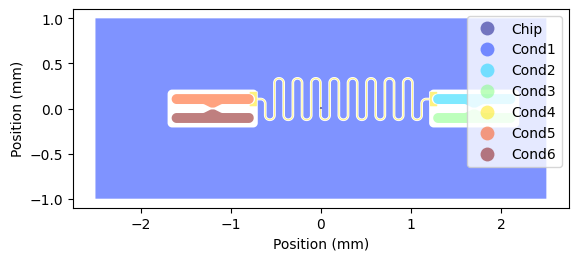
#Display the indices of the conductors to match with capacitance matrix - it will be automatically generated with the output anyway
cap_sim.display_conductor_indices()
plt.show()
[7]:
# Gives qubit parameters
results = cap_sim.calc_params_2_floating_transmons(print_all_capacitances=True,
                                            qubit_freq=(qubit_freq),
                                            res = resonator
                                            )

###
Capacitance Results
--------------------
C1-Ground        =     73.452 fF
C2-Ground        =     79.691 fF
C3-Ground        =     73.500 fF
C4-Ground        =     79.727 fF
CQ1              =     78.826 fF
CQ2              =     78.839 fF
Cg1              =      7.124 fF
Cg2              =      7.163 fF
C_r              =   1445.730 fF
C1_prime         =     85.915 fF
C2_prime         =     85.967 fF
C_r_prime        =   1458.830 fF
Cg1_prime        =   8800.541 fF
Cg2_prime        =   8757.446 fF

Readout Resonator
-------------------
f_res            =      6.800 GHz
L_res            =    745.009 pH
C_res            =    735.294 fF
Circuit Parameters
-------------------
f_qubit1         =      4.500 GHz
f_qubit2         =      4.500 GHz
E_C1             =    225.457 MHz
E_C2             =    225.321 MHz
E_Cc             =      0.183 MHz
g1               =     82.732 MHz
g2               =     83.176 MHz

Target Junction Parameters
 (for f_qubit1 = 4.5 GHz)
--------------------------
E_J1             =     12.380 GHz
L_J1             =     13.203 nH
E_J1/E_C1        =     54.912

Target Junction Parameters
 (for f_qubit2 = 4.5 GHz)
--------------------------
E_J2             =     12.387 GHz
L_J2             =     13.196 nH
E_J2/E_C2        =     54.975

Q1-Q2 g12        =      0.006 GHz
Q1-res g1        =    301.813 MHz
Q2-res g2        =    303.386 MHz
Q1 freq (uncoupled) =      4.500 GHz
Q2 freq (uncoupled) =      4.500 GHz
Res freq (uncoupled) =     30.333 GHz
Z on/off ratio   =      1.121
[8]:
print('Res_ground: ',capMat[0,3]*1e15, 'fF')
print('Pad1 to pad2: ',capMat[1,2]*1e15, 'fF')
print('Res to pad1: ',capMat[1,3]*1e15, 'fF')
print('Res to pad2: ',capMat[2,3]*1e15, 'fF')
Res_ground:  -1445.730348239 fF
Pad1 to pad2:  -35.65852572964 fF
Res to pad1:  -17.64799832657 fF
Res to pad2:  -2.3543623043 fF
[9]:
resonator.get_res_inductance()
[9]:
7.450087032524837e-10